Martinis, Marathons and Getting Gingered Up

"The Most Beautiful Marathon in the World"

“The World’s Most Beautiful Marathon”

“To believe this story you must believe that the human race be one joyous family, working together, laughing together, achieving the impossible. Last Sunday, in one of the most trouble-stricken cities in the world, 11,532 men and women from 40 countries in the world, assisted by over a million black, white and yellow people, laughed, cheered and suffered during the greatest folk festival the world has seen”

Olympic champion Chris Brasher wrote these words after running the New York City marathon in 1979.  He went on to found the London Marathon, the biggest marathon in the world.

Endurance runners are a bunch of weirdos who volunteer to undergo serious pain for hours.  I’m one of them.  I figure it’s a sort of karmic suffering, to offset the martinis I drink every evening. Once an oddity, marathons are now a cause for city-wide celebrations wherever they are held.  The outrage caused by the attack on the Boston marathon was felt not just by Bostonians and Americans but by runners around the world.

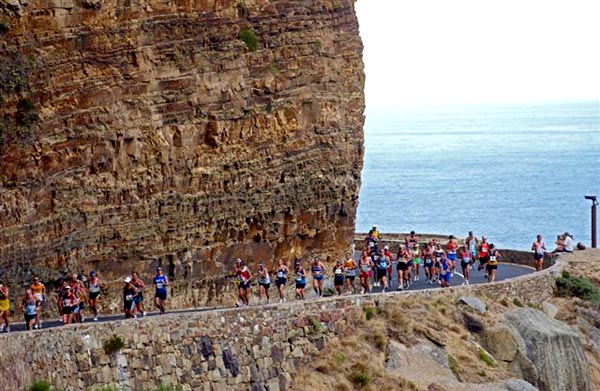
Thoughts of outrage were far from my mind as I lined up with 10,000 other pain junkies on a chilly morning in Cape Town.  We were running the Two Ocean’s Ultra Marathon – a gorgeous 35 mile (56k) trot from the Indian Ocean to the Atlantic. The race covers a hilly coastal route which snakes around the Cape of Good Hope. It is arguably one of the most beautiful races in the world and has long been on my bucket list.  My support team included mum, sis, brother in law, 5 year old nephew and a group of friends including an African Queen, a party hostess with a van (great for lying down in after the race) and Voldemort, the German masseuse.

Marathoners in Africa face unique challenges.  Last year a runner was hurt by rock throwing baboons.  The South Africans are a tough lot.  While most of them run in takkies (South African slang for sneakers or trainers), I came across a bunch of barefoot runners.  They weren’t some hunter gatherer types from the bush either, but slightly overweight middle class white people…

Runners greet pain like an old friend.  We wait for him to cross the road, meeting him halfway.  He runs alongside us, sometimes in the background, but always there.  He mocks us as our legs start cramping.  Six hours later I beat him and went out for a martini.

Il Leone Mastrantonio

Il Leone Mastrantonio

Pre race I focused on carb loading. After the race, my mind was on martinis.  For carb loading I visited two stand-out Italian restaurants in Cape Town –  Societi Bistro and Il Leone Mastrantonio.  Of the two Societi is a lighter, more modern interpretation of Italian cuisine, while Il Leone is more traditional. Off Orange Street in the Gardens district the Societi Bistro has a simple yet modern Italian menu with an emphasis on fresh ingredients.  The homemade spaghetti with truffle oil was delicious as was a simple salad of roasted figs and fior di latte (fresh buffalo mozzarella).

Il Leone Mastrantonio is in the district known as De Waterkant (say it with a straight face).  Il Leone is the grande dame of Italian restaurants in Cape Town.  It is pretty straightforward Italian fare served in a traditional, smartish, yet family friendly atmosphere.  The home made ravioli and rib of beef was the perfect pre race dinner.

Gorgeous red lacquered bar at Tjing Tjing

Gorgeous red lacquered bar at Tjing Tjing

The Cape Town Jazz festival kicked off after the ultra marathon and I hung out for some cool tunes and cocktails at the rooftop bar at Tjing Tjing on Longmarket Street.  Longmarket is a street favoured by students; lined with bars, backpacker hotels and massage parlours.  Three floors above street level, Tjing Tjing is an Asian inspired rooftop oasis, with inventive cocktails made from behind a shiny red lacquered bar.

Ginger is the new sexy ingredient in cocktails.  The term “gingering up” (or sexing up) came from the old gypsy habit of inserting ginger up a horse’s arse to make it appear frisky and alert while being inspected for sale.  The Ginger Ninja at the Tjing Tjing bar had vodka, grenadine, pineapple juice, bitters, ginger and lime.  The pineapple added sweetness, but the kick came from the ginger, offset by orangey grenadine flavours. There was no horsing about here – this is a nicely made drink.

The Jelly Baby was made with vanilla vodka, Cointreau, pomegranate juice, lemon juice and yes, jelly babies.  There was a candy like sweetness to the drink, offset by the tartness of the lemon juice.  It is an improbable sounding drink, but it grows on you.  If you are a girl.

Stunning Presentation of a Ginseng and Ginger Martini at the Pot Luck Club

Stunning Presentation of a Ginger & Ginseng Martini at the Pot Luck Club

The highlight of my culinary and cocktail tour of Cape Town was the Pot Luck Club at the Old Biscuit Mill in the Woodstock district.  Built at the top of a grain silo that serviced the former biscuit mill, the Pot Luck Club is a superb Asian fusion restaurant with stunning views.  There was more ginger in the cocktails here.  I had a Sake Cocktail with ginger, lemon grass and passion fruit.  This was a very successful blending of flavours, with the lemon grass and passion fruit combining to add a hint of bitterness, while the ginger left a nice after burn in the throat.

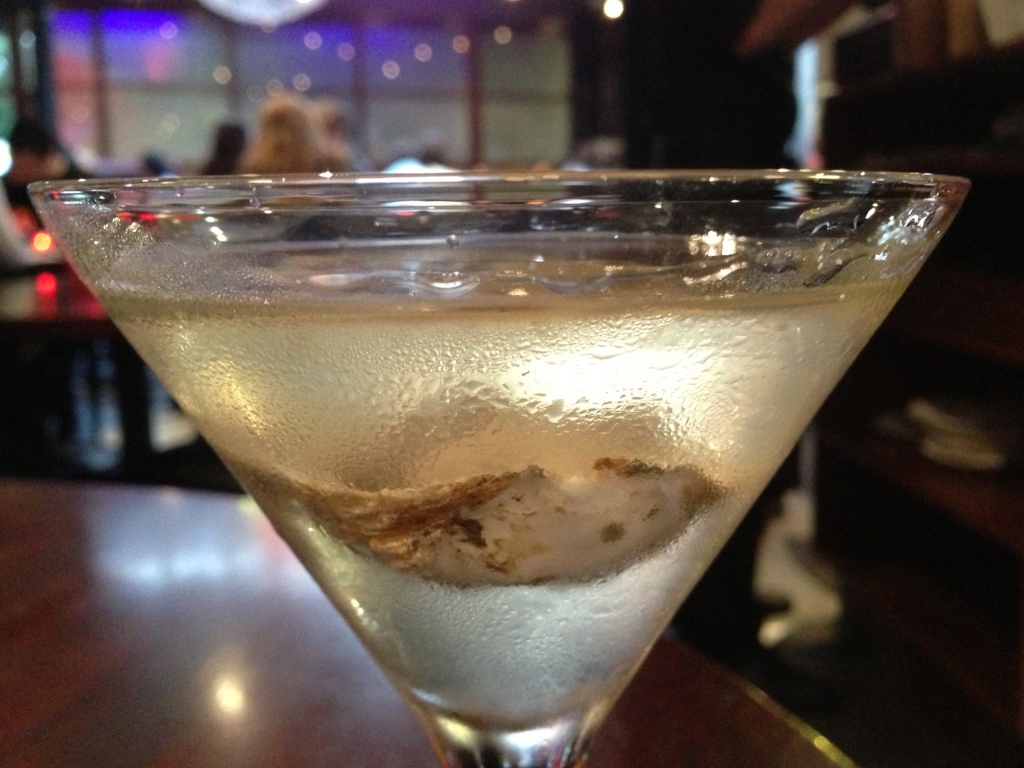
The Ginger & Ginseng martini is a stunning looking cocktail, the liquid made cloudy with ginger, served in an antique goblet with a  garnish of preserved ginger.  The ginger overwhelmed the ginseng however, making for a spicy cocktail lacking in complexity.

Sake, Campari, Watermelon.

Sake Compressed Watermelon with Blood Orange Sorbet and Bitter Campari Jellies at the Pot Luck Club

The big hit of the night was an alcoholic dessert.  Watermelon is infused with sake and then compressed until it turns jelly-like in consistency.  It is accompanied by blood orange sorbet and bitter Campari jellies.  This is a bitter dessert that looks a bit like a living thing and tastes divine.

South Africa is home to several great road races.  Apart from the Two Ocean’s there is the Comrade’s 56 mile (90k) race between Durban and Pietermaritzburg.  This is the world’s oldest and largest ultramarathon race.  I politely declined the offer to run in place of a friend in this year’s race.  Perhaps next year…

Other

A big thank you to Kensington Place, my favourite boutique hotel in Cape Town.  Austen Johnson and his team took care of all my marathon prep including a cooked breakfast delivered to my room at 3am, plus carb snacks for the race.  Meeting points for my support crew were carefully mapped out and taxis arranged.  It is a hotel I go back to often!

The Dry Martini Song

A little over a year ago I set out on a quest to find the world’s best martini. It was actually an excuse to go drinking around the world and to tell all my friends about it.  Surprisingly, many of you actually appear to read this blog.  A subsidiary benefit has been the invitations to go drinking with you in search of an epic “Martini Mandate evening”.  I thank you for your support!

martini-2

I also discovered that a parent exercising his creative juices in public is deeply embarrassing to one’s offspring.  When the parent decides to pick up a guitar and make music it becomes a truly cringeworthy exercise.  It had to be done!

So here it is, The Dry Martini Song - an anthem to drinking martinis, a lament about poorly made martinis. It is a song that will make you want to pour another drink, if only in the hope of blocking it from your memory forever.

“It’s a banker’s drink.  They deserve this song”  The Guardian

“She should have poured that martini on his head!”  The Bartender’s Union

“It has good advice on mixing a dry martini.  The rest of the song is rubbish”  Rolling Stone

“Phoar! Follow the instructions on mixing a martini, turn up the volume and she’s yours! Killer!”  Loaded

“We wish he hadn’t done it”  My Children

martini-clip-art-4


Click on the link to hear  The Dry Martini Song.   Thank you for listening!

Serendipity is a Tamarind Martini

Howzat! World class cricket is usually on offer in Sri Lanka.  New Zealand gets thrashed in Galle.

Howzat! World class cricket is usually on offer in Sri Lanka. New Zealand getting thrashed in Galle.

Take a fun loving tropical island nation and lock the people up for three decades.  Then throw open the doors and let the sun shine in.  That is what’s happening in Sri Lanka as the nation gets used to the idea of living without a civil war.  The country is busting loose as it throws off its shackles and enjoys life in the 21st century.  Named by Lonely Planet as the number one tourist destination for 2013 and cited by the New York Times, Conde Nast Traveller and National Geographic Traveller as a top holiday destination, the country is experiencing a 50% year on year increase in tourist arrivals.  As the winter chill grips London and New York, I chased the sun and escaped to Sri Lanka.

The ride from the airport to Colombo is hair raising. Some countries drive on the left hand side of the road, some countries drive on the right.  In Sri Lanka they appear to drive in the shade.  Driving in Sri Lanka is a contact sport.

Arriving at my mother’s house an hour or so later, I needed a tipple.  What to drink?

The national brew is distilled from the unopened flowers of the coconut palm. Each morning at dawn, men walk between coconut palms on tight ropes, collecting the nectar.   The liquid naturally and immediately ferments into a milky coloured, mildly alcoholic drink called toddy or palm wine.  On beach vacations my parents would give us kids fresh toddy – guaranteed to make sure we fell asleep and didn’t bother the grown ups.  Get your beachfront hotel or local friends to procure toddy for you – it should only be drunk fresh and isn’t commercially available.  Local toddy taverns are grotty working men’s drinking holes where you squat on the ground and drink out of coconut shells.  Don’t.

A toddy tapper at work

A toddy tapper at work

To make a more refined brew, toddy is poured into wooden vats made of teak or halmilla where the natural fermentation continues.  Pot stills enter the process at some point resulting in a beverage called Arrack (about 35% alcohol by volume).  The drink has a golden whiskey hue.  It’s flavour falls somewhere between whiskey and rum, sweeter than scotch but with a powerful aftertaste.   Arrack is widely available in Sri Lanka and is usually drunk with soda or ginger beer.  Old Reserve remains my favourite brand.  Harvey Nichols sells Sri Lankan arrack in London.

The local beers, made in the hill country in breweries established by the Brits are good strong lagers.  Lion Lager is a personal favourite.  The Victorian Brits also distilled gin in Sri Lanka. The quinine in the tonic water in a G+T protects against Malaria.  A good reason to imbibe. Rockland’s Gin is a delightfully aromatic gin – in London you can find it at Purl and the Worship Street Whistling Shop  (for a review read Maggie Thatcher and Drinking Baby Milk Formula).

For a non-alcoholic beverage, stick to king coconut water. It costs £3.00 (US $5) for a can at my gym in Notting Hill.  A few pence will get you the fresh stuff in Sri Lanka.  Drink it straight out of the coconut, for an authentic if slightly dribble ridden experience.

Tamarind Martini at the Gallery Cafe.  Vodka, Vermouth, Tamarind Liquid.  Chilli on the rim.

Tamarind Martini at the Gallery Cafe. Vodka, Tamarind Juice, Amaretto. Chilli on the rim.

No trip to Colombo is complete without sipping a cocktail at the Galle Face Hotel.  Established in 1864 this is the oldest hotel east of the Suez.  Its guest list includes Mark Twain, Anton Chekov, John D. Rockefeller, Yuri Gagarin, Richard Nixon and various members of British royalty.  It’s listed in the book 1000 Places to See Before You Die. On arrival, waiters padding silently in bare feet greet you.  On my last visit a purposeful looking security guard prowled the garden armed with a slingshot to chase away crows.  Anything fancy will test the bartenders here – ask for a simple Gin and Tonic or Arrack and Soda.  Hang out by the salt water pool naturally refreshed by currents from the Indian Ocean and enjoy the sunset.

The Galle Face Hotel.  Sit where Chekov sat and raise a glass...

The Galle Face Hotel. Sit where Chekov sat and raise a glass…

Sticking to the colonial theme I usually meet friends at the Colombo Rowing Club (it is a member’s only establishment so get a local friend to take you).  Racing sculls are stored on the ground floor.  Upstairs is a wonderfully atmospheric teak paneled room, open on three sides, overlooking the Beira Lake.  Wooden plaques commemorate long forgotten rowing victories against colonial rivals. Fan blades churn the air overhead, moving the air and keeping the mosquitos at bay.  The draft Lion Lager is excellent here as is the spicy devilled seafood.

Live jazz at Qbaa

Live jazz at Qbaa

The hottest venue in Colombo currently is Qbaa where I listened to live jazz and blues while sipping a margarita.  Financed by cricket legend Sanath Jayasuriya, it offers a sophisticated drinking and dining experience.  There is an extensive cocktail menu, but I find that sticking to standard summer cocktails is generally advisable in Sri Lanka – mixologists are thin on the ground.  Margaritas, Cosmopolitans and Mojitos are generally safe.  If you want to push the boat out on cocktails try the Floor by O overlooking the cricket pitch at the Colombo Hockey and Football Club.  They are seeking entry into the Guinness Book of World Records for the most number of cocktails on a menu – they currently boast over 1500.   I love the tamarind martinis at The Gallery Café, served in the former office of Geoffrey Bawa, the premier South Asian architect of his generation.

Inside at the Gallery Cafe

Delightful decor at the Gallery Cafe

Sri Lanka is firmly entrenched in the South Asian tradition of dynastic rule.  Get a flavour for it at Tintagel, the former residence of Prime Minister S.W.R.D. Bandaranaike, his wife Sirima (the world’s first woman prime minister) and their daughter Chandrika Kumaratunga (a former President).  In a macabre twist you can walk on the spot where Mr Bandaranaike was fatally shot by a Buddhist monk.  That’s the problem with holy rollers – you never know when they are packing heat under their robes.

Tintagel: a suitable venue for a prime minister

Tintagel: a suitable venue for a prime minister

The Bandaranaike’s were ardent socialists and nationalised many private enterprises, effectively destroying them.  At the height of his campaign MPs avoided the Men’s Room at the House of Parliament, worried that they might bump into the rather fay prime minister who was known to nationalise anything big…

It is ironic that the home of socialists is now home to an upmarket French/European hotel and restaurant catering to a very capitalist clientele.  If you really want to eat European food in Sri Lanka or impress a local lass, go.  The food is good, the decor is divine.  Bring your own booze however, since the last time I visited, Tintagel couldn’t get a liquor license on account of being located near a school.

This is the time to visit Sri Lanka.  The most expensive cocktail I could find cost only 980 rupees (about £5 or US$ 7), but prices are rising fast as the country finds its feet and gets firmly onto the tourist circuit.  Watch some cricket, lie on a beach, catch some rays, sip a cocktail.  No wonder Horace Walpole coined the word Serendipity (finding something good without looking for it) after visiting Serendib, the ancient name by which Arab traders referred to Sri Lanka. Go!

Insider Info

My boyhood friend Nishad Wijetunge and his wife Budeni run the excellent Wayfarers boutique travel agency whom I use to arrange all my holidays in Sri Lanka.  Tell him I sent you.

Cocktails, Clerics and Reincarnation

20121116-145918.jpgThe wire frame Buddha at Buddha Bar London.

Organised religion is a mass of contradictions. Ostensibly about peace, love and brotherhood, it is also a justification for war, killing thy neighbour and stoning people you don’t like. The priesthood reflects the contradictions. Religious clerics are a mixed bag of the selfless, the charming, the boringly righteous, the political opportunists, the odd child molester, and people wanted for questioning by the CIA.

Growing up in Sri Lanka we practised a cafeteria style approach to Buddhism, picking and choosing the bits we liked and blithely ignoring the inconvenient. We dislike killing animals (it is banned), but rather like eating meat. So the country has Muslim and Christian butchers. Goats run scared because unlike pork or beef, its meat is not banned by any religion and can be happily served to Hindu, Jewish and Muslim guests.

20121116-134634.jpgA case in point of a cleric getting hooked up with the wrong crowd. Abu Hamza my favourite Mad Mullah, now a guest of the CIA.

Christians are great – they eat everything, unless they are from California in which case you have to convince them that everything is organic. I did make a fish curry recently for some Californian friends who worried that the fish I chose was not organically raised. One woman worried that it may have been contaminated by swimming in sewage infected waters. I told her not to worry, pointing out that sewage is organic. Somebody kicked me under the table.

I was gazing at a rather interesting wire frame image of the Buddha whilst sipping a cocktail at the newly reincarnated Buddha Bar in London. Naming a bar after a religious figure is a risky proposition. Pick the wrong religion and you could have a fatwa on your hands. Fortunately, Buddhists are a patient lot – they’ll probably wait and get you in the next life.

The Buddha Bar concept was kicked off in Paris in 1996 by Claude Challe, a one time rabbinical scholar turned hairdresser. It offers a seductive mix of cutting edge world/ambient music, creative cocktails, Asian fusion cuisine and beautiful people. Some years later the concept was franchised and went global. The London branch was a victim of bad timing and lasted just 18 months before closing down in May 2010.

20121116-150644.jpgA Japanese whisky based Manhattan and the Ying Coco Yang.

I have a soft spot for the old Buddha Bar in London, having spent a fun evening there with some accountant friends (yup, they do let their hair down sometimes, if they have any) on its last night. Once we left, others from their firm came in at dawn, bolted the doors and shut the place down! Back then it was located on the embankment, a few doors down from the Walkabout, where antipodeans go to drink cheap beer and meet cheaper dates. The reincarnated Buddha Bar is in a posher location in Knightsbridge across from the luxury development at One Hyde Park, where the apartments retail for between £20 and £140 million (US $ 31m-190m).

While the location is posh, Buddhists would argue that it has bad karma. Many restaurants have come and gone from this venue, the Chicago Rib Shack being the last.

There is a bar upstairs and a large restaurant space in the basement for 240 covers. It is an open space decorated with a vaguely Asian motif. The aforesaid Buddha wireframe dominates, throwing interesting shadows. The floors and ceilings are in dark wood, while the chairs are upholstered in oriental fabrics. Asian woodcuts separate the dining areas.

I like the room, but it felt like a transplant from another era. I guess this happens with reincarnation sometimes. What was edgy once seems slightly dated and cliched now. The music is still good, but not that special anymore. The cocktails have intriguing Asian ingredients, but others do the same thing now. The nearby Mandarin Bar at the Mandarin Oriental hotel does Asian inspired cocktails rather well.

The menu at the Buddha Bar is pricey – £28 (US $50) on average for a main course reflects a pre-Lehman pricing strategy. £75 (US $ 120) for the cheapest bottle of sake is plain bonkers. Thankfully the wine list is more accessible.

20121116-150355.jpgDelicious but expensive food.

The Buddha Bar cocktails are good and not unreasonably priced at £10.50. I tried a Ying Coco Yang. Made with coconut cream, fresh lime juice and chilli infused gin, it was an interesting take on a piña colada with the chilli punch nicely counterbalancing the sweetness of the coconut cream. The So Be @ Miami was light and refreshing, made with fresh mint, grapefruit, vanilla sugar and teo infused gin. It was reminiscent of a longer, lighter version of a mojito made with gin instead of rum, with some citrus highlights. It looked fabulous! The Manhattan made with Japanese whisky, umeshu and plum bitters was less successful. I had an intriguing version of this drink at Bugsy’s in Prague a few weeks ago (see 40 minutes, a large cigar and an Arabian adulteress) The proportions and the ingredients in the Buddha Bar version didn’t quite work – the whisky flavours dominated and burned without being mellowed by the other ingredients.

The Buddha Bar had been open less than a week when I visited. There were rough edges still being worked out, service being one of them. It’s in a good location for a post retail cocktail; Harvey Nichols and Harrod’s are around the corner. The music is good, as are the cocktails. Can it avoid the life and death samsara cycle that affected other restaurants at this address? I don’t know. Perhaps it’s time for a prayer.

More Grooviness

The Buddha Bar in Paris is still a fine venue. For a different take on the ambient sound and fine cocktails experience I like the Hotel Costes in Paris. Apart from a groovy sound track you have the advantage of being able to roll into bed should the cocktailing leave you unsteady on your feet. The rooms at the Costes are very nice.

Buddha-Bar London on Urbanspoon

40 minutes, a large cigar and an Arabian adulteress

If something feels good there’s usually somebody out there trying to ban it. When it comes to booze all kinds of whacked out religious types ranging from Christians to Hindus, Buddhists and Muslims have tried to ban it. Jews haven’t tried to ban booze, they just try to make you drink kosher wine which pretty much puts everyone off.

I was in the capital of the ancient Kingdom of Bohemia where they had just announced a ban on spirits. Someone was adulterating the good stuff with methanol, which can make you go blind. As hangovers go, that must rank amongst the worst. The Bohemians took it in their stride; every drinking hole I visited in Prague had a different interpretation of the ban!

I have huge admiration for the Czechs. Their ancient nation had a horrible 20th century. The Nazis and the Russian Communists wiped out two thirds of the population of Prague, during World War 2. The communists then ruled for over 40 years with an iron fist. Yet the “Velvet Revolution” that freed them was bloodless. There can’t be that many revolutions led by a poet, who then celebrated with a jazz jam session with President Bill Clinton on sax. And they love Absinthe.

The problem with Prague is that it’s over run by drunken Brits. Most nationals behave badly when they travel overseas. Americans are famously loud, boorish and larger than life, or sometimes just large. Brits are drunk and randy; they gather in Prague for extended stag and hen weekends. Given that more than 50% of marriages in the UK end in divorce, there is a perverse logic to celebrating impending doom and huge expense by getting shit faced and sleeping with someone whose name you won’t remember. A British woman wearing a flashing “L” sign and smelling of weed and lager blocked my escape route one night. We tried talking but she was more stoned than an Arabian adulteress…

20121025-174746.jpg
An illustration from the lavish cocktail menu at Bugsy’s

Escaping randy drunks and the slightly gangsterish Eastern European nouveau riche, I made my way to Bugsy’s, one of Prague’s finest cocktail lounges. Bugsy’s (as in Bugsy Malone’s) is a basement venue with vaulted ceilings bathed in soft red lighting. A DJ was spinning a sophisticated Buddha Bar-like sound track. Bugsy’s celebrates a properly old world drinking experience. The cocktail menu is published as a lavish book, featuring sexy, black and white illustrations. There is a huge cigar case by the entrance. Most things are legal in Prague, including smoking in bars and prostitution.

20121025-171349.jpg
Jakob the bartender at Bugsy’s carefully lights my cigar

Jakob my bartender was knowledgeable about all there was on offer at the bar. He carefully talked me through the tasting notes on their extensive selection of Cuban and Dominican cigars and helped me select a medium bodied Dominican Ti Amo tubelo which he said should last me about 40 minutes. “A woman is a woman, but a cigar is a good smoke,” opined one of his regulars, approving of my selection. He looked like a man who’d know.

The cocktails ranged from gloriously traditional to wonderfully creative, with some uniquely Czech twists along the way. The Martini Number One was a very traditional gin martini with orange bitters – the original martini recipe usually included bitters. The Thai Tini featured coriander vodka with watermelon – a light, delicate drink. I had a fabulous twist on an Old Fashioned made with Japanese plum whisky and homemade pineapple and white pepper bitters. The sweetness of the plum whisky stood up well to the peppery bite of the bitters. Becherovka, an herbal bitters which is the Czech national drink, featured in the Lolita, topped with sparkling wine and lychee. Becherovka is a pleasant aperitif by itself, tasting of anise and cinnamon, not dissimilar to a pastis. In the Lolita it added bottom and complexity to a long drink.

20121025-171555.jpg
A Plum Old Fashioned being prepared with Japanese whiskey

The Czechs have a proud old tradition of brewing some of the world’s finest pilsners. The original Budweiser, brewed since 1785 and sold under the
Budweiser Budvar label in Western Europe is a complex beer – a far cry from the watery American brew of the same name. It is sold as Czechvar in the US. Pilsner Urquell however, is the Czech Republic’s most celebrated beer; the world’s first pilsner beer, brewed since 1840 in Pilsen.

At Ambient Lokal, a funky pub which featured huge steel vats of unfiltered Pilsner Urquell, the party trick is to vary the levels of Carbon Dioxide in your beer. “Sweet”, “slice” and “creme” pours feature increasing levels of CO2. The creme is basically a glass of thick foamy head – surprisingly refreshing and slightly sweet. One has to drink it quickly before it settles.

I couldn’t taste the absinthe because of the spirits ban but I did try the local pear brandy, a delightfully clear palate cleanser reminiscent of grappa.

20121025-171502.jpg
Delightful Czech pear brandy at Ambient Lokal

Prague has a lot to offer. While traditional Czech cuisine is a bit heavy on meat and potatoes, there are some very good international restaurants. Kampa Park, under the Charles Bridge is a particular favourite with great food and superb views of the old town. Ask for a table at water level. By the time you read this you may even be able to drink the absinthe again. Cheers! Na zdravi!